


Ever been to a party where everyone’s just staring at their phones? If you’re looking for a simple fix for those awkward silences, you’ve found it. There’s an incredibly fun and easy game that gets everyone talking and laughing, no complicated rulebook required. It’s the perfect secret weapon for any host trying to break the ice. To learn more, check out ufa169
This magical solution is a “categories game,” a type of creative word game anyone can play. The idea is simple: you get a category, like “Things You Find at the Beach,” and have to come up with an answer. Unlike trivia, there are no obscure facts to memorize. Instead, the fun comes from the clever, surprising, and often hilarious answers your friends invent on the spot. It’s one of the best party word games because it levels the playing field for everyone.
What makes it one of the top icebreaker games for large groups is its brilliant scoring. In most versions, you only get points for unique answers. If you and another person both write down “seashell,” you both get nothing! This simple rule encourages people to think outside the box, rewarding creativity over quick recall and leading to guaranteed laughter as answers are read aloud.
Best of all, you don’t need to buy a fancy box to play. All you need is a pen, some paper, and a few fun category ideas for parties to get started tonight. Here are the simple rules, how to play, and everything else you need to turn your next get-together into a memorable one.
What Exactly Is a Categories Game?
At its heart, a categories game is beautifully simple. You’re given a topic, like “Things you find in a kitchen” or “Movie Stars named Chris,” and your job is to quickly come up with an answer that fits. The fun isn’t just in finding an answer, but in finding one that nobody else thinks of. It’s a fantastic word association game for groups because it’s all about fast, creative thinking.
Unlike a typical trivia night, this type of game rewards originality over pure knowledge. If the category is “Fruits” and you write down “Apple,” chances are several other people did, too. But if your answer is “Ugli Fruit”? You’re probably the only one. This simple twist turns it from a test of memory into a celebration of cleverness, where the most surprising answer is often the best one.
The result is a game full of laughter and surprising “aha!” moments as you discover how your friends’ and family’s minds work. It’s less about winning and more about the hilarious conversations that pop up along the way.
How to Play Right Now (With Just Pen and Paper)
The best part about this game is that you don’t need a rulebook or a store-bought box. If you’ve got friends, a few pens, and some scraps of paper, you have everything you need to play one of the best group games without materials. Here’s how to set up a round in under a minute.
This simple, five-step process works every time:
- Grab Paper and Pens: Give one to each player. Everyone will need something to write with.
- Pick a Category: One person calls out a category for the round. Keep it simple and fun, like “Types of Breakfast Cereal” or “Things You Find at the Beach.”
- Set a Timer: Pull out a phone and set a timer for 60 to 90 seconds. This short window is key—it creates a fun, low-stakes scramble!
- Write Down Answers: Once the timer starts, everyone privately writes down as many answers as they can think of that fit the category. No shouting them out yet!
- Share Your Lists: When the timer goes off, pens go down. It’s time to take turns reading your answers aloud.
That ticking clock is what turns a simple brainstorm into an exciting race. Don’t worry about spelling or perfect handwriting; the goal is just to get your ideas down before time runs out. You’ll be surprised how fast a minute goes by when your brain is scrambling for another word for “dog” or a movie that starts with “T.”
Now for the moment of truth: sharing your lists. This is where the real fun begins, as you hear the clever, surprising, and sometimes hilarious answers everyone came up with. But how do you determine a winner from these lists? It all comes down to one simple, brilliant rule about being unique.
The Secret to Winning: Why Unique Answers Are Gold
Now that everyone’s lists are ready, you might assume the person with the most answers wins. But here’s the clever twist: it’s not about who wrote the longest list, but who wrote the most original one. The goal is to come up with answers that no one else at the table thought of. This is how you win at word category games, and it’s where the real fun is hiding.
The scoring rule is brilliantly simple. As each person reads their answers aloud, listen carefully. If you wrote down the same answer as someone else, you both have to cross it off your list—no points for either of you! You only score a point for each answer that is uniquely yours. For a category like “Fruits,” several people might write “Apple,” and they would all get zero points for it. But if you were the only one to write “Persimmon,” you get the point.
This simple system is what makes the game so hilarious and replayable. It actively discourages obvious answers and rewards creative thinking. You’ll quickly learn to skip the first idea that pops into your head and dig for something more surprising. This leads to those fantastic moments where someone shares a bizarre but technically correct answer that makes the whole room laugh. It’s a creative thinking game for groups where being different isn’t just fun—it’s how you score.
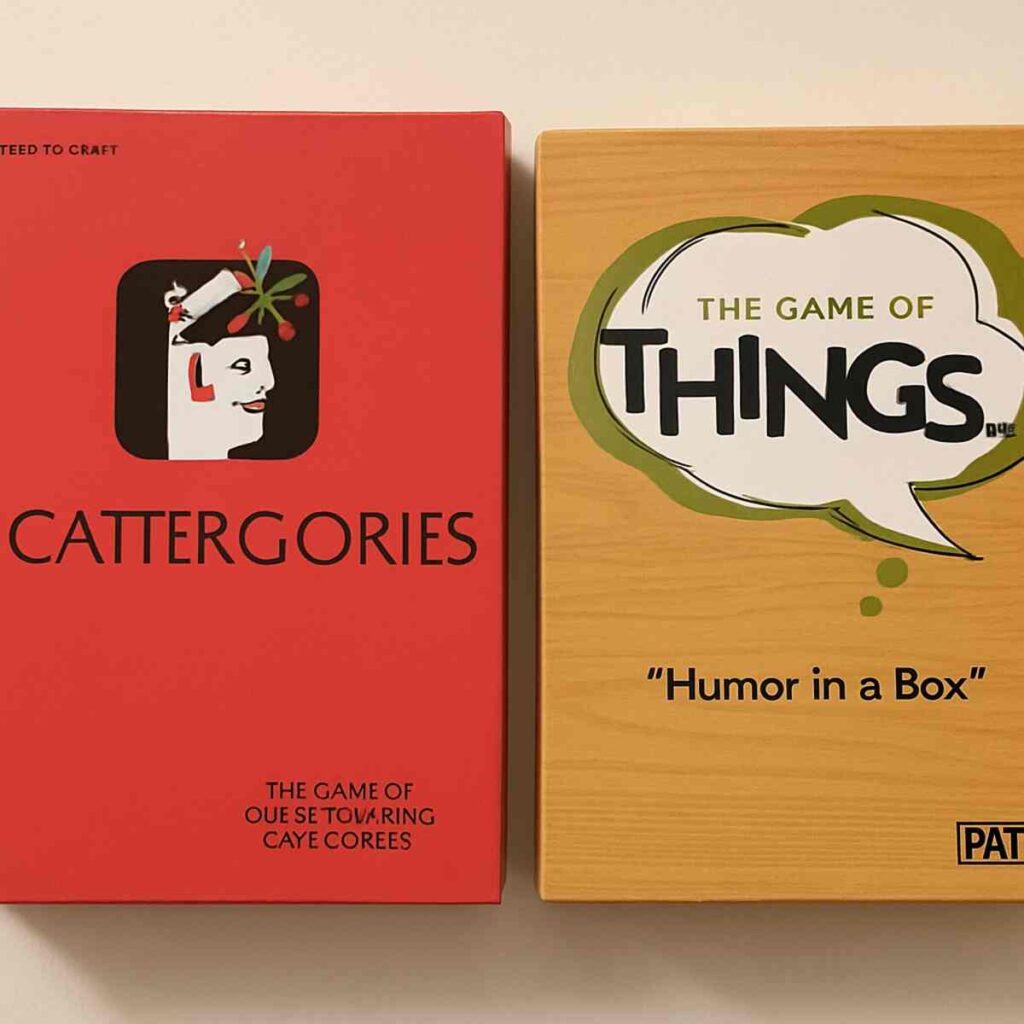
Comparing Popular Store-Bought Games: Scattergories vs. Things…
While you can play a fantastic categories game with just pen and paper, sometimes it’s nice to have everything you need in one box. Two of the most popular party word games, Scattergories and The Game of Things…, take the basic idea in two wonderfully different directions. One tests your speed and vocabulary, while the other tests how well you know your friends.
You’ve probably heard of Scattergories; it’s a classic for a reason. The game takes the standard category challenge and adds a key twist: you have to come up with answers that start with a specific letter, determined by a roll of a 20-sided letter die. If the category is “Things in the Kitchen” and the letter is “P,” you’re scrambling for answers like “pot,” “pan,” and “pepper grinder.” It’s a game of quick thinking and word recall, all under the pressure of a timer.
On the other hand, The Game of Things… throws out the pressure of being “correct” and focuses entirely on humor and personal creativity. This game is less about what you know and more about what you think. The categories are prompts for opinions, silly ideas, and funny memories, making it a perfect icebreaker.
The real magic is in how to play The Game of Things…. One person reads a topic card, like “Things you shouldn’t do at a wedding.” Everyone else anonymously writes down an answer on a slip of paper and turns it in. The reader then collects all the answers—from the clever to the completely absurd—and reads them aloud. Players then take turns trying to guess which person wrote which hilarious or outrageous response.
So, when choosing between them, the best choice depends on your group. Do you want a fast-paced battle of wits? Go with Scattergories. Are you looking for a game that sparks conversation and personal stories? The Game of Things… is your winner. While many versions use cards for their categories, it does raise the question: Is a game like Scattergories technically a card game?
So, Is Scattergories a Card Game?
It’s a fair question, especially since so many party games use cards. The short answer is that classic Scattergories is actually a board game. The version most people know comes in a box with player folders, answer pads, a timer, and that famous 20-sided letter die. While there are newer card-only versions on the market, the original game that became a household name doesn’t rely on a deck of cards to play.
This highlights a simple but useful distinction: the difference between a game’s format and its gameplay. The format is the physical stuff you play with—a board, dice, or cards. The gameplay is how you play—the rules and the core action. So, while the format of Scattergories is a board game, its gameplay is the very heart of a categories game: thinking of unique answers under pressure.
Ultimately, the label doesn’t matter nearly as much as the fun you’re having. Whether you’re playing a board game like Scattergories, a true categories card game like Things…, or a version you made up with pen and paper, the goal is the same. It’s all about sparking creativity and laughter, proving the best part of the game isn’t what’s in the box, but who is sitting around it.
Tips to Spark Your Creativity (and Win More Laughs)
The secret to this game isn’t just knowing a lot of things; it’s about thinking in a way that leads you away from the crowd. Since matching answers gets crossed out, the most obvious choice is often the worst one. The real fun—and the points—come from the answers no one else sees coming. This is the heart of any creative thinking game for adults: finding a new angle on a simple idea.
One simple trick is to be hyper-specific. If the category is “A type of dessert,” instead of writing down “cake,” which is almost guaranteed to match, get more detailed. Think “that slightly burnt lemon pound cake my grandma makes” or “a convenience store ice cream sandwich.” The extra layer of detail dramatically lowers the chance that someone else wrote the same thing, turning a generic answer into a unique, and often funnier, one.
Another way to find unique answers is to think more abstractly. Don’t just consider the literal meaning of a category. For “Something that can fly,” go beyond “bird” or “plane.” What about “a rumor,” “time,” or “a temper”? This kind of word association can lead to the most surprising and memorable moments of the game, where everyone laughs and says, “Oh, that’s a good one!”
Ultimately, the best “strategy” is to aim for answers that are clever, personal, or just plain funny. The goal isn’t just to win points, but to win laughs and spark conversation. A surprising answer that gets a reaction from the group is a win in itself.
Your Printable Starter Pack: 50+ Fun Category Ideas
Coming up with good categories on the spot can sometimes be the trickiest part of the game. To make sure you’re always ready for a round, we’ve put together a printable category list for your next game night. Whether you’re playing with kids, breaking the ice at a party, or just looking for a good laugh, you’ll find fun category ideas for parties and family gatherings right here. Feel free to mix and match, or use these as inspiration to create your own!
Here are some tried-and-true categories to get you started:
Family-Friendly Fun
- Animals at the zoo
- Things in a classroom
- Breakfast cereals
- Types of fruit
- Things you find at the beach
- Cartoon characters
- Items in a backpack
- Superpowers
- Round things
- Board games
- Pizza toppings
- Things you do at a birthday party
- Holiday movies
- Ways to travel
- Four-letter words
Perfect Party Icebreakers
- Reasons to be late for work
- Things you find in a junk drawer
- Skills you wish you had
- Things you shouldn’t say out loud
- Something you’d buy with $100
- Celebrities you’d invite to dinner
- Annoying sounds
- Apps on your phone
- Overrated things
- Excuses to get out of a meeting
- Things you find under a couch
- Bad first date ideas
- Common fears
- Things you procrastinate on
- Something that makes you happy
For a Bit of Silliness
- Things you shouldn’t lick
- Bad names for a pet rock
- Weird things to find in a car
- Terrible superhero names
- Things you’d do with a million dollars
- Unlikely things to hear a pilot say
- Alternative uses for a banana
- Things you can’t buy online
- Bad names for a band
- Unusual ice cream flavors
- Things a dog is probably thinking
- Jobs on the North Pole
- Souvenirs from a terrible vacation
- Things you shouldn’t juggle
- Phrases that sound better with a British accent
Don’t be afraid to get creative and tailor the categories to your group. Inside jokes, shared memories, or favorite TV shows all make fantastic prompts that lead to the most memorable answers.
Get Ready to Play: Your New Favorite Game Night Awaits
You came here looking for a simple activity and now have everything you need to lead one tonight. You know the straightforward rules, how to play for free with just pen and paper, and even have a list of topics to kick things off. Nothing is standing between you and a memorable, fun-filled evening.
This is the real power of great party word games. They aren’t about complicated strategy, but about the surprising answers and the laughter that fills the room. As one of the best icebreaker games, it’s a simple, family-friendly idea designed purely for connection and creativity. You’re not just playing a game; you’re creating an excuse to have fun together.
All that’s left to do is make it happen. So, what are you waiting for? Grab some paper, gather your favorite people, and find out who can name a “Vegetable that starts with the letter Q” the fastest.