


Most people think game design is just about having a great idea for a story or character. While creativity is essential, in practice, an idea alone isn’t what lands you one of the many entry-level game designer jobs. So, what truly separates a fan with an idea from a professional game designer? Check out the Best info about link AMOSBET77.
The answer lies in understanding the designer’s specific role as the “architect of fun.” A Game Artist creates the visuals and a Game Programmer writes the code, but the Game Designer builds the experience. They are the ones who design the rules, the challenges, and the systems that make a game engaging from one moment to the next, which is a key difference when considering a game design vs game development degree.
Think of the classic Super Mario Bros. A designer made the crucial decision: jumping on a Goomba defeats it. An artist then drew the iconic character, and a programmer wrote the code to make that interaction happen. The designer’s job is to focus entirely on the “what” and “why” of the fun.
To communicate this vision, designers create a master plan called a Game Design Document (GDD). This document acts as the blueprint for the entire project, detailing everything from character abilities to level layouts. Learning how to create a professional GDD is one of the most valuable skills you can develop.
Game Design vs. Game Development: What’s the Difference for Your Degree?
As you search for programs, you’ll see the terms “game design” and “game development” used almost interchangeably. In the professional world, however, they represent two very different things. This distinction is the first step in choosing the right path for your career and finding a degree that matches your actual interests.
The easiest way to think about it is that Game Development is the entire process of making a game from start to finish. It’s the umbrella term that covers everyone on the team: the programmers who write the code, the artists who create the characters and worlds, and the producers who manage the project. It’s the entire orchestra, from the first chair violin to the person operating the lights.
Within that big picture, Game Design is a specialized role focused on one question: “What makes this game fun?” The designer is the architect of the experience. They don’t typically write final code or create finished 3D models. Instead, they design the rules, the layout of the levels, the feel of the controls, and the systems that challenge and reward the player. They are the directors guiding the rest of the team toward a cohesive, engaging vision.
This difference is crucial when looking at a game design online degree. A program titled “Bachelor of Science in Game Development” often signals a more technical, programming-heavy curriculum, preparing you for a role as a software engineer. In contrast, a “Bachelor of Arts in Game Design” typically centers on the creative and analytical skills—the psychology of play, narrative structure, and systems thinking—that shape the core experience of the game itself. Knowing which side of the coin excites you more will guide you to the right curriculum.
What You’ll Actually Learn: A Peek Inside an Online Game Design Curriculum
Now that you know a game designer is the architect of fun, you might wonder what’s in their toolkit. An online degree is designed to give you exactly that—a structured way to learn the craft. Instead of just having ideas, you’ll learn the practical skills to transform those ideas into playable, engaging experiences. These programs are less about memorizing facts and more about building, testing, and creating.
Most game design courses focus on a core set of creative and technical skills. Think of these as the fundamental requirements of any video game design curriculum. You won’t just talk about what makes a game great; you’ll get your hands dirty learning how to build it. A typical program will guide you through:
- Game Mechanics Design: This is where you create the rules and actions. A mechanic is as simple as the jump in Super Mario Bros. or as complex as the crafting system in Minecraft. You’ll learn how to design actions that are satisfying and fun to repeat.
- Level Design: You’ll learn to build the actual spaces where the game takes place—from a single puzzle room to a massive open world. This involves guiding the player, creating challenges, and setting a mood, much like designing a theme park ride.
- Narrative Design: This is the art of telling a story through gameplay. You’ll learn how to weave a plot into the world and actions of the player, rather than just showing it in cutscenes.
- Prototyping: This is one of the most vital skills. A prototype is a simple, playable version of a game idea used for testing. By learning Unreal Engine for game design (or other popular tools like Unity), you’ll build dozens of these small “sketches” to see what works and what doesn’t, long before any art or complex code is involved.
Why Your Portfolio is More Important Than Your Diploma
Here’s a secret about the game industry: employers care more about what you can do than what your diploma says. When you apply for a job, the first thing they’ll ask for isn’t your transcript; it’s your portfolio. This is a collection of your best work, serving as a digital resume that proves your skills by showing, not just telling. It’s the single most critical asset for anyone seeking a creative-technical role.
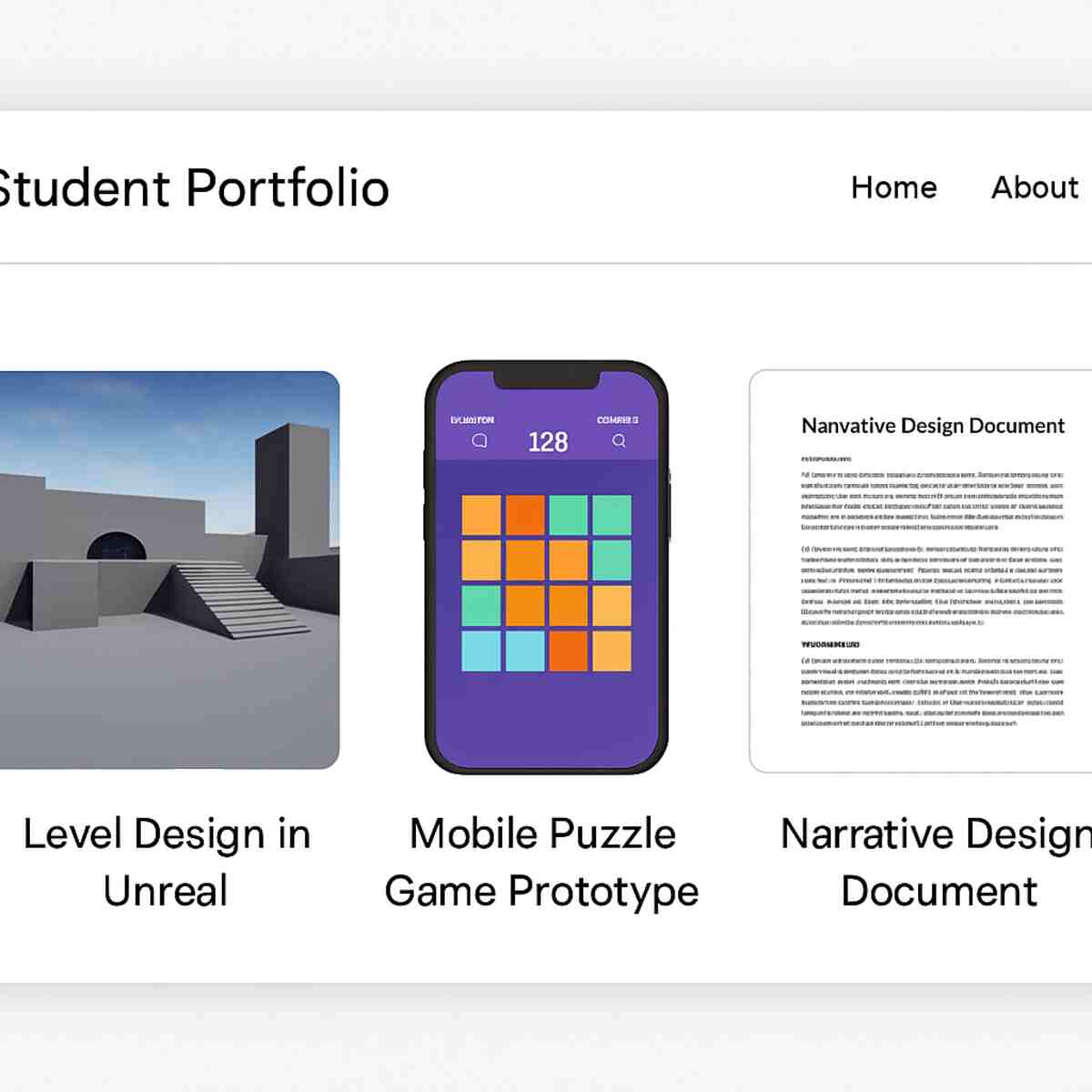
So, what goes into a game design portfolio? It’s not about flashy, finished artwork. Instead, it showcases your design thinking. This is where the prototypes, level designs, and narrative documents you created in your classes come into play. A strong portfolio might feature a playable prototype of a puzzle game, a document outlining the mechanics for a new character, or a video walkthrough of a level you built in Unreal Engine. It’s the evidence of your ability to solve problems and create fun.
This is arguably the single biggest advantage of a structured degree program. Every project, from your first simple prototype to your final capstone game, is a potential piece for your collection. You’re not just completing assignments for a grade; you’re actively learning how to build a game design portfolio for college and beyond, all with expert feedback from instructors who know what hiring managers look for.
Your portfolio is your key to landing entry-level game designer jobs. It’s the body of work that makes a studio director say, “This person knows how to design a game.” But this raises an important question: if building a portfolio is the main goal, could you just teach yourself and do it on your own?
The Big Question: Is a Game Design Degree Worth It vs. Being Self-Taught?
It’s the ultimate question for any aspiring creator: with a world of tutorials online, do you really need a degree? The honest answer is no—plenty of successful designers are self-taught. However, the path is often longer, less certain, and requires immense self-discipline. The choice between a game design degree vs self taught boils down to structure versus total freedom.
The two paths offer very different journeys to building that all-important portfolio. While one isn’t universally “better,” a degree provides a guided, accelerated experience designed to get you job-ready faster.
- Structure:
- Online Degree: A guided curriculum ensures you learn everything from design theory to engine basics in a logical order, leaving no gaps in your knowledge.
- Self-Taught: You decide what to learn and when, which offers flexibility but risks missing fundamental skills.
- Feedback:
- Online Degree: Receive direct, professional feedback on your work from professors who are industry veterans and from peers on the same journey.
- Self-Taught: You rely on public forums or social media, where feedback can be inconsistent, and it’s hard to know who to trust.
- Networking:
- Online Degree: Instantly connect with a network of classmates, alumni, and career services that have relationships with game studios.
- Self-Taught: You must build every professional connection from scratch, often by attending events or through cold outreach online.
Beyond the curriculum, a degree program provides two things that are difficult to replicate on your own: mentorship and deadlines. Having an instructor who can guide your projects and answer tough questions is invaluable. Likewise, the structure of assignments forces you to finish projects and build your portfolio, pushing you past the creative blocks that often stall solo learners.
So, is a game design degree worth it? If you thrive with a clear map, expert guidance, and a built-in support system, the investment can pay for itself by providing the most direct route to a professional portfolio and a career. While many affordable online video game design programs are available, the key is finding one that delivers real value.
How to Spot a Great Online Game Design Program (and Avoid the Duds)
With so many options advertised online, it can be tough to tell the difference between a powerhouse program and a diploma mill. When you’re trying to figure out how to choose an online game design program, don’t just look at the marketing materials. Instead, use this four-point checklist to investigate what really matters.
- Accreditation. This is the single most important factor. Accreditation is a seal of approval from an official reviewing agency, proving a school meets high academic standards. Crucially, only accredited online game design schools are eligible for federal financial aid (like Pell Grants and student loans). If a school isn’t accredited, you’ll be paying entirely out of pocket.
- Industry-Experienced Faculty. You want to learn from people who have actually shipped games. Look up professors on LinkedIn or MobyGames (a massive online database of game development credits) to see if they’ve worked at real studios.
- A Clear Curriculum Focus. Is the program truly about design (rules, systems, levels), or is it one of the best online colleges for game art and animation, or a degree focused on programming? A great program knows its specialty. Make sure it aligns with your passion.
- Proven Career Outcomes. The goal is a job. Look for alumni success stories, connections to studios, and dedicated career services. Where do their graduates work? A good school will be proud to show you.
Choosing the right program is about investing in a launchpad for your career, not just a piece of paper. A strong curriculum taught by industry veterans is what builds a portfolio that gets you hired. But once you have that portfolio, what jobs can you actually get?
Beyond ‘Game Designer’: What Jobs Can You Actually Get?
While many people think “Game Designer” is a single job title, it’s actually a broad category, much like “doctor.” Just as there are surgeons and pediatricians, the game industry has many specialists who focus on one part of the player experience. Knowing what jobs you can get with a game design degree helps you find the path that fits you best. These roles are where your great ideas are forged into a real, playable game.
On a professional team, the work is divided among experts. As you study, you might find you have a passion for one of these specific entry-level game designer jobs:
- Level Designer: The architect of the game world. You build the maps, place the enemies, and craft the moment-to-moment missions players navigate, from a Call of Duty multiplayer map to a dungeon in The Legend of Zelda.
- Systems Designer: The creator of the game’s rules. You design and balance how things like combat, skill trees, or in-game economies work to ensure they are fair and fun.
- Narrative Designer: The interactive storyteller. You don’t just write the plot; you design how the player experiences it through quests, dialogue choices, and environmental clues.
- UI/UX Designer: The link between the player and the game. You design the menus, health bars, and on-screen icons to be intuitive and easy to understand.
- Quality Assurance (QA) Tester: The bug hunter. You meticulously play the game to find, document, and help solve technical problems before it reaches the public.
A great degree program will expose you to each of these areas, helping you build a portfolio that showcases your specific talents. For those looking to specialize deeply or change careers, an online master’s in game design can provide an even more focused path toward becoming an expert in the field you love most.
Your First Quest: 3 Ways to Start Your Game Design Journey Today
You’re no longer just a player. The next time you launch your favorite game, you won’t just see a beautiful world; you’ll see the architecture behind the magic. You can now spot the mechanics, question the level layouts, and appreciate the careful decisions that separate a good game from a great one. This new perspective is one of a game designer’s most fundamental tools, and you’re beginning to develop it.
But understanding is just the beginning; the real excitement comes from doing. Before you even think about formal game design courses, you can take your first real steps as a creator today. Try these simple, no-risk experiments to see what sparks your passion:
- Explore a Game Engine: Download Unity or Unreal Engine for free. The goal of learning Unreal Engine for game design at this stage isn’t to become an expert overnight. Simply follow a “My First Game” video tutorial on YouTube to see how the digital pieces fit together.
- Deconstruct a Game: Play for 30 minutes, but with a notebook. Write down every single action you can perform—jump, open, talk, craft. You’ve just created a list of its core mechanics, a key design skill.
- Write a One-Page Design: Brainstorm an idea for a simple mobile game. On a single page, describe its goal, the key player actions, and the one thing that will make it uniquely fun.
Whether you eventually pursue one of the many online game design certificate programs or continue to forge your own path, remember this moment. The journey from player to creator doesn’t begin with an acceptance letter or a tuition payment. It begins with that first curious download and that first page of notes. You haven’t just learned what a game designer does—you’ve already started becoming one.
